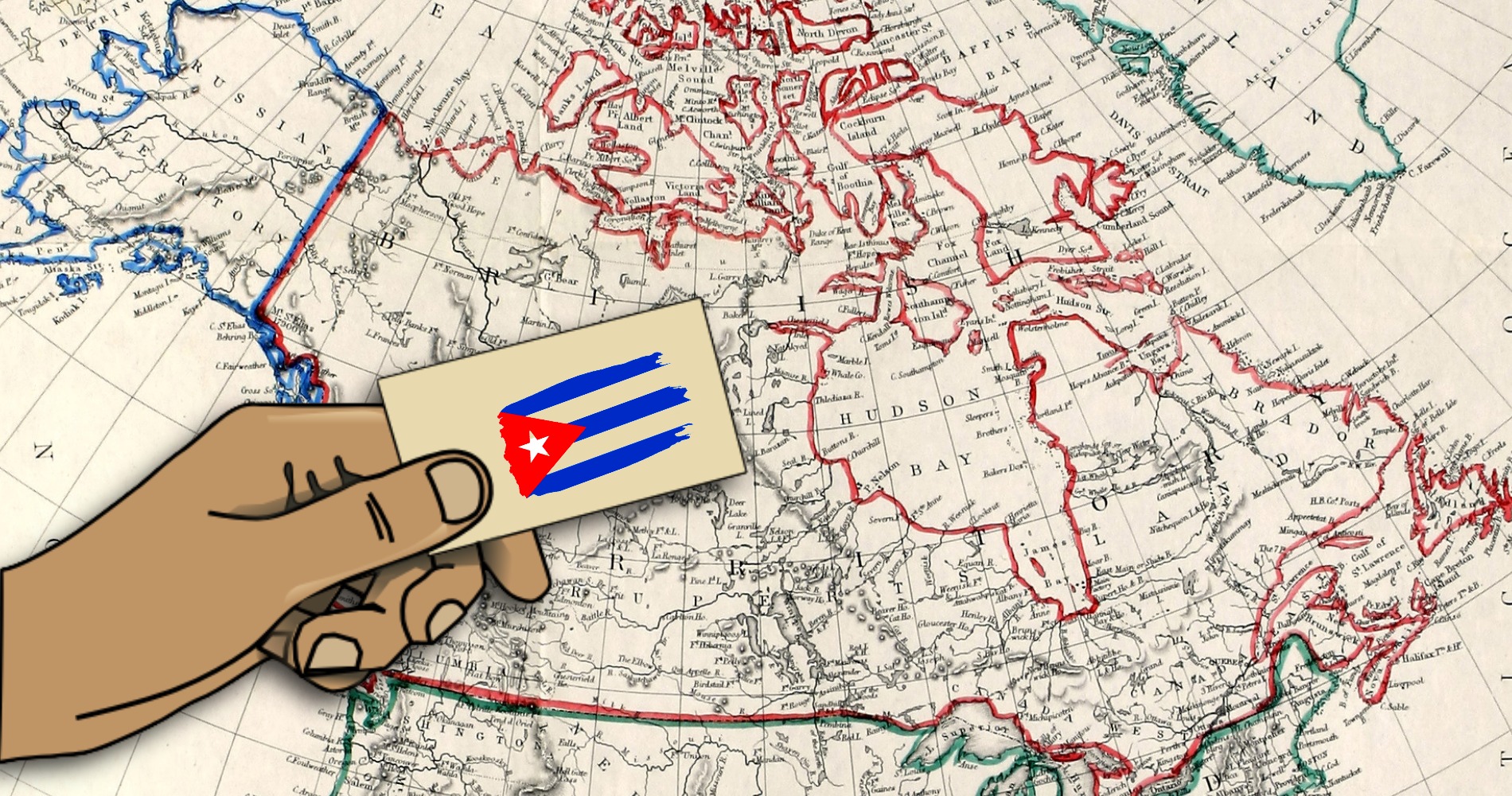
Playing the “Cuba card” has allowed for Canada to assert an independent foreign policy from the United States. It’s time to play it again.
April 30, 2026
Written by Fred Wilson (originally published by CCPA)
The Canadian government has made quite a show of its rhetorical shift away from the United States on trade, defence, and foreign policy alignments—presenting itself as a “middle power” in a new international order. That rhetorical shift often fails to stand up to the reality of deep U.S. integration—and one place where that contradiction is extremely clear is Canada’s relationship with Cuba, where Canada is actually acting less independently from the U.S. than it has historically.
For most of the 67 years since the Cuban revolution, successive Canadian governments played the “Cuba card” to assert independence from U.S. hegemony—that is, they have refused to align themselves with the United States’ hostile approach to Cuba, and used that lack of alignment to differentiate themselves from the U.S. on the world stage. Today, Canada’s failure to play the Cuba card stands out as a confounding failure of Canadian policy and resolve.
To date, Prime Minister Mark Carney has made no comment or statement on Cuba. In February, Foreign Minister Anita Anand refused to condemn the U.S. fuel blockade and announced $8 million in humanitarian assistance to be delivered through UN agencies—described as a “modest and indirect” and paltry by comparison with assistance provided by Mexico and other countries. In April, Anand announced a further $5.5 million in medical assistance to be delivered through the PanAmerican Health Organization.
The federal government has been pestered repeatedly to show leadership. NDP House Leader Don Davies and Bloc Quebecois Leader Yves-François Blanchet have both made direct appeals to Carney to provide fuel and assistance to Cuba. The Canadian Labour Congress and multiple Canadian unions have called on Canada to assist and defend Cuba, and parliamentary petitions have received tens of thousands of signatures. Canadian labour, faith and solidarity organizations have launched a new campaign to pressure the Canadian government to act.
Parliament’s Foreign Affairs Committee held two days of hearings on the situation in Cuba stacked with four organizations invited as witnesses—all of them émigré groups hostile to Cuba. The case for Canadian cooperation with Cuba was left to the beleaguered Cuban Ambassador Rodrigo Malmierca Diaz. While little to nothing in the way of support for Cuba resulted, Liberals Steven Guilbeault and Rob Oliphant, as well as Bloc Quebecois MP Alexis Brunelle-Duceppe spoke up for solidarity with Cuba.
To state the obvious: Canada has opted to avoid making Cuba another source of friction with the Trump administration. But it is a long descent from Canadian defiance of the U.S. blockade on Cuba by former Prime Minister John Diefenbaker in 1960, or Pierre Trudeau’s Havana visit in 1976 (the first by a NATO leader after the Cuban revolution). The Cuba card also gave us the 1984 Foreign Extraterritorial Measures Act, first invoked by the Mulroney government in 1990 to protect Canada Cuba trade from extraterritorial sanctions by the U.S.. The FEMA was strengthened in 1996 by the Chretien government to explicitly make it illegal for U.S. courts to enforce the U.S. embargo on Canadian people and companies under the Helms Burton Act, the U.S. congressional act which codified the Cuba embargo into law..
And even after the the North American Free Trade Agreement (NAFTA) changed Canadian foreign policy—when, as Stephen Clarkson described, “the trade policy interlopers achieved ideational dominance in their new home in the Department of Foreign Affairs and International Trade,”—Cuba remained somewhat of an exception to the integrationist agenda.
Canada-Cuba relations survived a decade of Cold War politics during Stephen Harper’s time as prime minister. “These guys personally don’t like Cuba. They don’t like communists. And so, they’re still fighting the Cold War,” said Carlos Dade, the head of the government-financed Canadian Foundation for the Americas (FOCAL). At the 2012 Summit of the Americas in Colombia, Canada was the only country to support the U.S. decision to exclude Cuba from participating. However, after Obama’s normalization of relations with Cuba in 2015, Harper met Cuban President Raul Castro in Panama City.
A year later, in November 2016, Justin Trudeau followed his father’s path and met Raúl Castro in Havana. The second Trudeau visit resulted in bilateral agreements to improve relationships and an invitation to Canada to be the host country of honour at the 2017 International Havana Book Fair. Before the ink was dry on those agreements, Fidel Castro died, and in a perverse consequence, altered a hopeful reengagement of Canada and Cuba.
Justin Trudeau issued a statement from the Prime Minister’s office on the death of Castro, a friend of the Trudeau family, and an honorary pallbearer at Pierre Trudeau’s funeral in Montreal:
“Fidel Castro was a larger-than-life leader who served his people for almost half a century. A legendary revolutionary and orator, Mr. Castro made significant improvements to the education and healthcare of his island nation… I know my father was very proud to call him a friend and I had the opportunity to meet Fidel when my father passed away. It was also a real honour to meet his three sons and his brother President Raúl Castro during my recent visit to Cuba. On behalf of all Canadians, Sophie and I offer our deepest condolences to the family, friends and many, many supporters of Mr. Castro. We join the people of Cuba today in mourning the loss of this remarkable leader.”
However, 17 days prior to Castro’s passing, Donald Trump was elected president of the United States for the first time. And while Barak Obama’s statement on the death of Fidel Castro offered condolences and “a hand of friendship to the Cuban people,” Trump’s statement underscored the abrupt reversal of U.S. policy to Cuba after Obama. He called Fidel “a brutal dictator who oppressed his own people for nearly six decades. Fidel Castro’s legacy is one of firing squads, theft, unimaginable suffering, poverty and the denial of fundamental human rights.”
U.S. Republicans, as well as Canadian Conservatives and media, launched an immediate attack against Trudeau for his statement. In the context of the moment, few came to his defence to uphold the friendship between Canada and Cuba that the Trudeau-Castro relationship had come to symbolize.
It was a turning point in Canada-Cuba relations. Only months later, the so-called Havana Syndrome began to make waves, as U.S. diplomatic staff claimed to have been targeted by an “energy weapon” which caused them to suffer debilitating headaches, nausea, and cognitive effects. While the veracity of such claims are highly disputed, they still resulted in a dramatic reduction of Canadian diplomatic presence in Cuba which continues today. The Trump administration, meanwhile, restarted and doubled down on U.S. sanctions and embargos against Cuba.
In 2019, Trump invoked a nuclear option on Cuba relations that no U.S. president before him had been prepared to use with the activation of Title III of the Helms-Burton Act. This provision made it possible for any American to sue for damages in U.S. courts against any company or party that had economic relations with Cuba relating to properties that had been nationalized. For Canada, it was also a direct rebuke of Canadian sovereignty and the Foreign Extraterritorial Measures Act. Canada’s then-Minister of Foreign Affairs, Chrystia Freeland, took the traditional Canadian position: “no judgment issued under Title III of the Helms-Burton Act will be recognized or enforced in any manner in Canada.”
Freeland’s objections to Title III were, however, subdued, partially due to her ideological framework that singled out Venezuela, Russia, and China as existential threats to liberal democracy. She championed American leadership and rejected criticism of the selectivity of her targets as “the Soviet trick of whataboutism.”
Freeland took the lead in the forming of the “Lima Group” of countries that recognized opposition politician Juan Guaido as the legitimate president of Venezuela. In 2019, Freeland met three times with her Cuban counterpart, each time linking opposition to Title III with her demand that Cuba disengage from Venezuela and facilitate regime change.
Still, after this long retreat, in 2024 Canadian academic and author Peter McKenna wrote:
“Playing the so-called ‘Cuba card’ or carving out a distinctive Cuba policy from that of the hardline U.S. posture, along with refusing to accept the strictures of Washington’s economic isolation of Cuba, still has political currency in Canada, and is indeed endorsed by many Canadians. Engaging with the Cuban government is clearly viewed by the political leadership in Ottawa as one of the seminal examples of Canada showcasing its policy-making autonomy on the world stage. Whether this nostrum is actually true or not, no Canadian government wants to willingly surrender the independence or sovereignty quotient derived from friendly relations with Havana.”
The Cuba card survived as an expression of Canadian sovereignty because of distinct layers of civil society connections that survived even as governmental relations hollowed out. These layers included the more than one million Canadian tourists who visited Cuba each year prior to the pandemic, and 750,000 who still did in 2025. It includes the significant civil society connections anchored in Canada by CoDevelopment Canada (CoDev), the Canadian Network on Cuba, and trade union exchanges and delegations. Not least, Canadian business and commercial relations with Cuba persevered in defiance of the U.S. economic blockade.
Canada’s commercial ties with Cuba amounted to C$910 million in bilateral trade in 2024. Tourism is a large part of that, of course, with Canadian companies like Sunwing (Westjet), and Blue Diamond (Royalton) hotels. It also represents $140 million in agricultural exports in 2025, primarily wheat.
Canada also imports over C$600million of goods from Cuba, and most of that is neither cigars nor rum. The single largest import is cobalt and nickel from Moa, Cuba to the Sherritt refinery in Fort Saskatchewan, Alberta. The resulting output from the Canada-Cuba joint venture mine and refinery is a key part of Canada’s Critical Minerals Strategy. The Fort Saskatchewan refinery is Canada’s third largest source of refined nickel and the majority of refined cobalt products essential for EV and aerospace batteries, electricity grids, superalloys for jet turbine components, communications hardware, satellite and aerospace materials.
McKenna’s affirmation that the Cuba card was still on the table, would be upended again just months later by the reelection of Donald Trump. A violent rupture in global affairs and a new menacing U.S. imperialism immediately followed, with the openly stated goals of annexing Canada and enforcing a so-called “Donroe” doctrine of U.S. dominance of the Americas, with Cuba a principal target. Canada-Cuba policy was collateral damage as the new Carney government manoeuvred in response to U.S. threats, but this approach sacrificed Canadian business and strategic Canadian interests.
In addition to the cancellation of thousands of flights and hundreds of thousands of tourist packages to Cuba, the U.S. fuel blockade on Cuba forced the Moa mine to suspend production in February—putting thousands of Cubans out of work, with Canadian refinery jobs at risk as well. Remarkably, there has been no response from the Canadian government to the U.S. actions disrupting critical supply chains to Canada.
To the contrary, the Canadian Commercial Corporation (CCC) Cuba Program, a long standing Export Development Canada program to support Canadian business in Cuba was discontinued in January, citing “a convergence of rising financial risk and deteriorating economic conditions.”
It is more than difficult to square the Carney government’s silence, inaction and thinly veiled hostility to Cuba with its own goals of trade diversification and “variable geometry” of middle powers uniting against economic coercion.
The European nations that Canada is seeking greater cooperation with are, for their part, engaging substantively with Cuba regardless of U.S. sanctions. Spain is restructuring Cuban debt to finance projects in strategic sectors including energy, water, and food security, involving Spanish companies in their implementation. The European Union’s active Cuban development and economic projects dwarf Canada’s with current funding running to 2027 and a larger EU program planned for 2028-2034.
Canada’s CUSMA partner, Mexico, has been outspoken in its opposition to U.S. aggression against Cuba and has responded with four massive naval shipments of food, medical and other supplies in February and March, and an additional US$35 million aid program to assist Cuban agriculture.
Notably, Cuba also has a Political Dialogue and Cooperation Agreement with the European Union, which has structured bilateral exchanges and reports on human rights, economic and social issues that inform EU cooperation and investments.
There is no such dialogue with Canada but the Cuban ambassador cited Carney’s Davos speech to the parliamentary committee and diplomatically claimed “a good political dialogue” with Canada. “We don’t avoid any issues. We discuss everything,” he said, “I believe we will find our way to continue constructing this respectful relationship, which has lasted for more than 80 years now.”
“We actively take on the world as it is, not wait around for a world we wish to be,” PM Carney famously said. But Canada has clearly made arbitrary choices to follow the money into some parts of the world and not others—see, for example, its new trade agreements with Indonesia, China, and Qatar, all of which are regularly accused of human rights abuses by the same bodies that accuse Cuba. In this context, Canada’s Cuba policy is confounding and riddled with contradictions, double standards and moral failure.
The Cuba card has been buried beneath decades of shuffles and misplays, but it remains a litmus test of Canadian sovereignty—one which will be played again because Canadians value it.
Leave a Reply