By José Ángel Portal Miranda*
In the complex landscape of contemporary geopolitics, economic figures often camouflage the real human impact underlying the decisions made by governments to achieve obscure political and economic objectives of domination in their relations with other countries—decisions that, on many occasions, put lives at risk. Irrefutable proof of this reality are the tools desperately and cruelly used by the United States Government against Cuba, which increasingly heighten the risks and threats to the lives of our people.
What has historically been an economic, commercial, and financial blockade for my country, lasting more than six decades, has recently mutated into a qualitatively different and quantitatively even more aggressive and inhumane phase: energy asphyxiation under false pretenses. Cuba suffers from the continuity of unilateral coercive measures with a massive extraterritorial impact on relations with all countries, and faces a systemic siege surgically designed to cause shortages capable of damaging and reversing our nation’s social development and the quality of life of our population for the purpose of destabilization.
The unjust inclusion of Cuba on the list of State Sponsors of Terrorism, combined with the persecution of Cuba’s commercial contracts with countries and companies to acquire fuel; the harassment, interception, and confiscation of vessels carrying fuel; as well as the threats of sanctions—and in other cases their effective application—against shipping companies, have generated even greater pressure that transcends the economic sphere to enter the realm of basic human security.
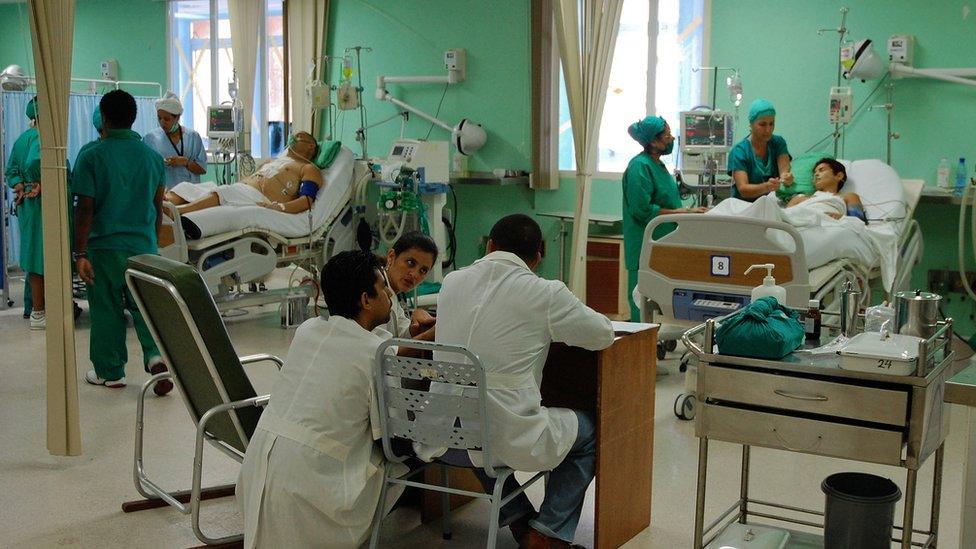
In the health sector, this reality translates into permanent objective tension: the National Health System depends on a continuous supply of electrical energy and logistics that are today severely hindered.
The impact of the U.S. policy of “maximum pressure” against Cuba is revealed starkly in the most sensitive indicators. Behind the numbers are patients who suffer and families who wait for solutions that are sometimes delayed, or do not arrive at all, due to external factors that are the result of this progressive policy of strangling the Cuban economy by the United States Government.
Currently, the surgical waiting list in the country has reached 96,387 patients, of whom 11,193 are children. With the current energy restrictions, these figures are increasing, forcing the National Health System to postpone non-urgent surgeries in order to prioritize oncological procedures and others that are life defining.
Vulnerability is heightened in high-priority social programs; yet, despite being prioritized, they are not immune to the compounded limitations caused by the country’s current energy situation.
For instance, the Maternal and Child Health Program is currently facing the challenge of ensuring follow-up for 32,000 pregnant women who require essential diagnostic ultrasounds. Likewise, the intermittency of refrigerated transport due to fuel shortages has hindered more than 30,000 children from receiving their vaccines in a timely manner, despite having the biological supplies available in our warehouses.
To this is added the care of 16,000 radiotherapy patients and another 2,888 who depend on hemodialysis—services that demand a level of energy stability that is currently very difficult to guarantee.
Nevertheless, despite these and other realities facing the National Health System, its operation is not in a state of collapse.
The response has not been paralysis, but rather a strategic reorganization based on resilience and resource optimization.
Among other actions, we continue to enhance the resolution capacity of Primary Health Care, strengthening the Family Doctor and Nurse Program, and utilizing tools such as telemedicine to ensure the vitality of basic services.
This capacity to respond rests fundamentally on the altruism, ethics, commitment, and professionalism of Cuba’s human capital, who do not live isolated from the country’s reality. Our workers and students suffer at home from the same shortages and long hours without electricity as the rest of the people they serve; even so, they transform each day’s challenges into new motivations to persevere and continue seeking alternative solutions to the lack of resources within the sector’s institutions. It is moving to see how, in provinces where 85% of neonatology specialists live outside the municipality where they work, extraordinary alternatives are being found to ensure that no newborn is left unprotected in the face of the transportation crisis.
The prestige of Cuban medicine has been forged through humanism and a sense of duty, not only within our borders but also in the 165 nations where Cuban health collaborators provide or have provided services for decades, as is the case in Mexico. Today, that same commitment is what sustains the National Health System, even under increasing pressure and the accelerated technical wear and tear of its infrastructure.
We feel with pride that Cuba is not alone, thanks to the solidarity we receive from the most diverse corners of the world. Our eternal gratitude goes to all sister nations and, most especially, to the Mexican people and Government, whose extended hand has been a special source of support for us in such diverse scenarios.
The appeal we have made to the international community is not ideological in nature, but deeply humanitarian. Public Health is a fundamental human right that should not be conditioned by political disputes or the use of energy as an instrument of coercion.
When energy is lacking, it is extremely difficult to maintain essential services, and when that happens, it is the people especially the most vulnerable—who bear the negative impact and pay the price for the risks of the tensions involved. Cuba will continue to adopt all possible measures to protect its population, which is currently suffering, more than ever before, the consequences of the cruel U.S. policy of suffocation.
In the face of this reality, our request to the international community remains to show solidarity in addressing the real and objective scale of a criminal siege that threatens life itself.
*Minister of Public Health of the Republic of Cuba.
Taken from El Heraldo de México
Leave a Reply