From the Center for Economic and Policy Research
A country’s infant mortality rate (IMR) is often considered a key barometer for a population’s overall health as well as its access to quality health care.1 In Cuba, where for decades the state has invested substantially in health care services, the IMR was, until recently, among the lowest in the Western Hemisphere and lower than in the US. Since 2018, however, Cuba’s IMR has increased from an annual rate of 4.0 per 1,000 live births to a rate of 9.9 as of 2025,2 representing an increase of 148 percent. If the rate of infant mortality had remained unchanged, then approximately 1,800 fewer babies would have died since 2018.
This striking increase in Cuba’s IMR, which is at variance with trends seen in other countries in the region, has taken place over a period (2017–2025) that has seen an unprecedented expansion and tightening of the US commercial and financial embargo that has been in place since the early 1960s. It is worth noting that, in the years following the global COVID-19 pandemic and again in contrast with nearly all of its regional neighbors, Cuba failed to experience a substantial economic rebound, averaging 0.4 percent annual per capita GDP growth between 2020 and 2024 versus 3.2 percent for the Latin American and Caribbean region as a whole.3
Recent studies show a strong causal relationship between sanctions imposed and increased death rates. In August 2025, a Lancet Global Health study estimated, based on a panel regression incorporating data from 152 countries, that broad, unilateral sanctions resulted in approximately 564,000 deaths annually over the years 2012–2021.4 The study also found that children under five years old accounted for 51 percent of these deaths. Infant mortality is generally about three-quarters of under-five mortality. These numbers therefore reflect a profound disproportionality in the impact of sanctions on infants and children under five years of age as compared with other age groups; infants are only about 1.6 percent of the world population.5
Sanction measures adopted by US administrations since 2017 are designed to cause economic damage to Cuba by further reducing its access to foreign exchange and international financial markets; such measures can, and appear intended to, cause recessions, depressions, balance of payments crises, and higher inflation, even hyperinflation — as similar sanctions have done in other countries. A 2022 paper published by the Bank for International Settlements found that “child mortality rises in a highly significant way in recessions in EMDEs [emerging market and developing economies], by about 6 deaths per 1000 births.”6 Again, these numbers are for mortality of children under five years old. As mentioned above, about three-quarters of this mortality in the world is infant mortality, so this study implies that a recession would increase mortality by 4.5 deaths per 1,000 births. This is most of the increase that the data show for Cuba (from 4.0 to 9.9, so an additional 5.9 deaths per 1,000 births).
The unparalleled hardening of US sanctions against Cuba during the first Trump administration, the Biden administration’s decision to largely maintain these policies, and the further expansion of sanctions during the second Trump administration, including a devastating fuel blockade, is very likely the primary cause of the current economic and humanitarian crisis in Cuba, which is widely considered to be the worst in the island’s contemporary history.
Among the most harmful measures imposed over the last eight years are the following:
- The Cuba Restricted Entities List, prohibiting transactions with most of Cuba’s major hotels and many other state-run businesses (created in 2017 by President Donald Trump).7
- Reduction of the de minimis threshold on Cuba to 10 percent, blocking all exports of foreign-made products to Cuba that include more than 10 percent US-origin content (tightened from 25 percent to 10 percent in October 2019).
- Far-reaching restrictions on US travel to Cuba, including ending the main travel license allowing travel to Cuba for individuals (June 2017) and for groups (June 2019; rescinded in 2022, reinstituted in 2025) and the banning of cruise and most private vessels/aircraft from calling at Cuba (June 2019).
- Re-inclusion of Cuba on the State Sponsor of Terrorism list,8 triggering potential onerous fines for international financial institutions that do business with Cuban entities and blocking citizens of 42 Electronic System for Travel Authorization-applicable countries (EU, UK, Japan, Australia, South Korea, etc.) from traveling to the US visa-free if they travel to Cuba (instituted on January 12, 2021).9
- The nonrenewal of the presidential waiver on Title III of the Helms-Burton Act, allowing US citizens and entities to sue third-party individuals and companies — including non-US companies — that engage in business with Cuban entities benefiting from nationalized properties (President Trump let the waiver expire in May 2019).10
- Measures restricting the flow of remittances, including caps on family remittances ($1,000 per quarter), bans of all donative remittances (ordered by President Trump on September 9, 2019; removed by Biden on June 9, 2022), and the addition of the Cuban firm that processes remittances for Western Union and other US companies to the Cuba restricted list in 2020. Operations resumed with a new Cuban partner in 2023, but this firm was also added to the list in January 2025, again closing the main channel for formal remittances and forcing reliance on costlier alternatives.11
- Sanctions and other pressure targeting officials of governments hosting Cuban international medical missions, leading to the departure of many of these missions and the steady erosion of Cuba’s primary source of foreign income (pursued by both Trump administrations).
- US fuel blockade — by far the most damaging US unilateral measure to date — consisting in the blocking of nearly all oil shipments from Venezuela through the use of coercive tactics employed by the US military, including the interception of tankers destined to Cuba by the US Coast Guard,12 as well as threats, including threats of tariffs directed at countries considering exporting oil to Cuba (pursued by President Trump since early January 2026).
In the aggregate, these measures have — by fueling steep reductions in export earnings from tourism, medical services, foreign investment, remittances, and so on and by cutting Cuba off from most international credit — stifled economic growth and significantly contributed to major balance of payments difficulties, leading to increased inflation, reduced imports of essential goods, and reduced economic growth. Given these conditions, it is unsurprising that Cuba is experiencing an acute economic crisis that has led to a major decline in living standards that has, in turn, resulted in an unprecedented number of departures from the island over the last few years. This crisis has been compounded by this year’s fuel blockade, which has prompted increasingly frequent and prolonged power outages and brought many essential services and economic activities to a halt.
While there aren’t available data to begin measuring the impact of this year’s fuel blockade yet, the other sanction measures cited above played a very large, sometimes predominant, role in the following developments:
- Tourist arrivals in Cuba fell by 53 percent between 2018 and 2024;13 neighboring countries with similar volumes of tourism experienced increases in arrivals or no significant change.
- Income from tourism fell 59 percent, from $3.2 billion in 2017 to $1.3 billion in 2024.14
- Export earnings from medical services (international medical missions) fell 23 percent, from $6.4 billion in 2018 to around $4.9 billion in 2022, the last year for which there are data.15
- Remittances fell 42 percent from $4 billion in 2018 to just $2.3 billion in 2024.16
- Domestic spending on goods imports fell from $11.5 billion in 2018 to $8.1 billion in 2024,17 a steep fall of 30 percent (or 19 percent in per capita terms) that is likely understated in the official data.
- According to Cuba’s National Statistics Office, Cuba’s population fell by 13 percent from 11.2 million in 2020 to 9.8 million in 2024,18 a rate of out-migration that far surpasses all prior episodes of intense out-migration from Cuba (such as the Mariel Boatlift in 1980).
These and other similar data reflect a rapidly deteriorating social and economic reality that has taken a major toll on the Cuban people. The human consequences of this decline include widespread undernourishment, a significant worsening of sanitary conditions, a rise in disease and sickness, and — as underscored above — an increase in deaths, particularly the deaths of infant children.
CEPR staff has also observed in situ how US sanctions measures have directly contributed to the deterioration of Cuba’s once exemplary health care sector, which is undoubtedly a factor that has contributed to the marked increase in Cuba’s IMR. During a 2024 trip to Cuba to assess the impact of the hardening of US sanctions, CEPR visited Cuban health care facilities and spoke to numerous health care providers. The visit confirmed that, as a result of the reduction of the de minimis threshold in 2019, Cuban medical importers were no longer able to obtain at affordable prices many basic medical supplies, such as syringes, inhalers, and even saline solution; more sophisticated medical equipment, such as imaging and ultrasound systems; and inputs for the manufacturing of pharmaceuticals. The re-designation of Cuba as a State Sponsor of Terrorism in 2021 has made it extremely challenging to obtain financing for the purchase of these goods — at any price — or to simply execute international payments to purchase them. The end result of these multiple barriers generated by these sanctions has been massive shortages of medical goods — supplies, equipment, medicines — that had once been far more readily available in spite of the long-standing US embargo.
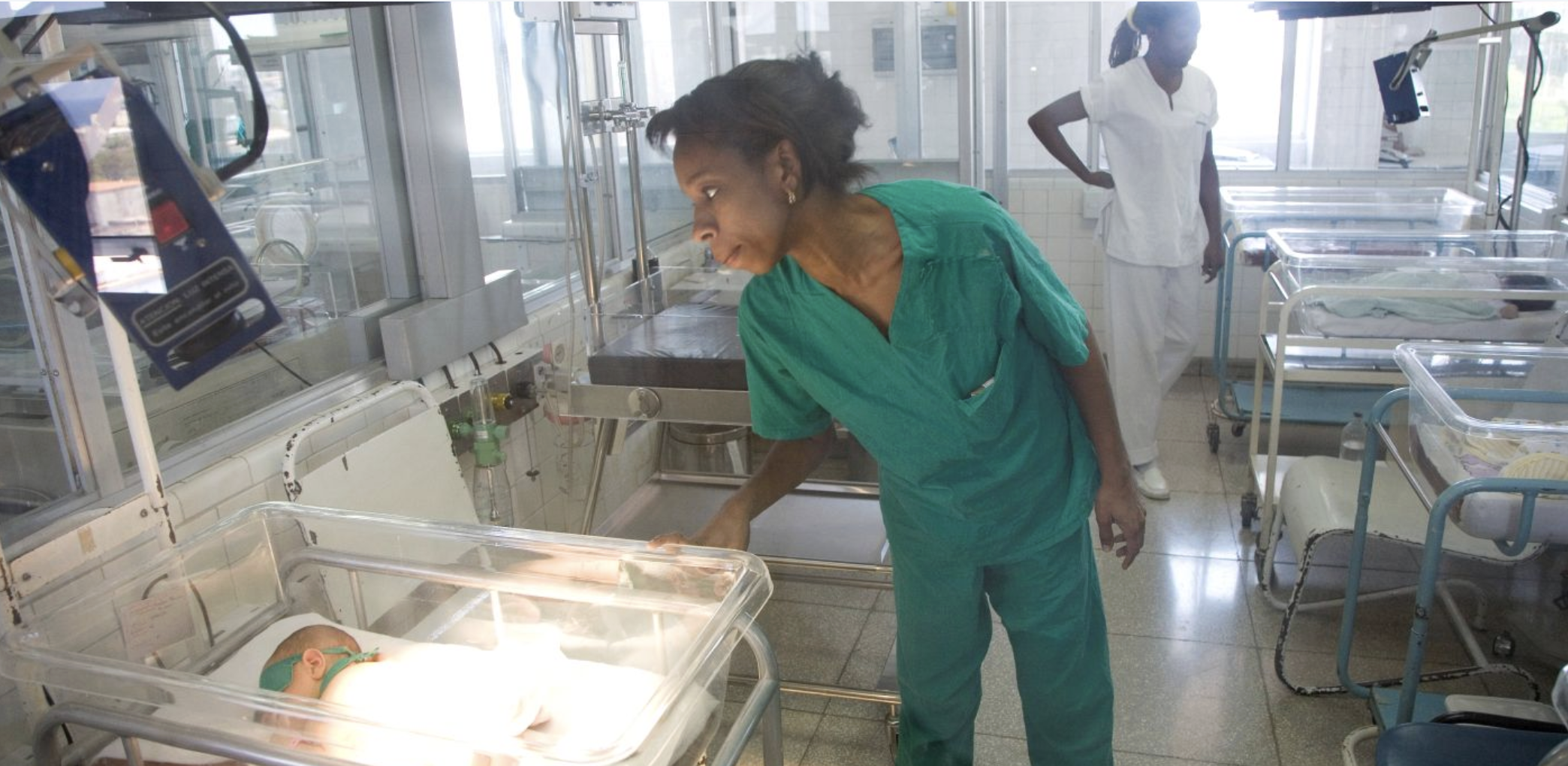
The situation in Cuba has declined even further since last year and could devolve into an even more severe humanitarian crisis as a result of the US fuel blockade. As a number of recent media reports have noted, the blockade has had a particularly dire effect on Cuba’s health care infrastructure, with frequent power outages interrupting the use of critical equipment for the treatment of patients, including incubators for premature babies and ventilators to help sick newborns breathe.19 There is virtually no available fuel to transport sick patients, whether by ambulance or in private vehicles — NBC reported in March that 300 ambulances are sitting idle for lack of fuel or parts, leaving only 25 electric ambulances to serve the entire island.20 Public transportation is paralyzed,21 leading to an even greater absence of medical workers in key facilities.22 None of this is surprising. In fact, these are precisely the consequences that could be expected from a fuel blockade targeting an island nation that only produces roughly 40 percent of the energy required to meet its domestic needs.
Given the effects of the US energy blockade, it is highly likely that Cuba’s infant mortality rate has increased significantly since December 2025 when it had reached 9.9 per 1,000 live births. Other key health indicators, such as life expectancy and maternal mortality, have also very likely deteriorated since the beginning of the year.
Read the entire study here.

Leave a Reply